Shell Emitter
2026-03-16
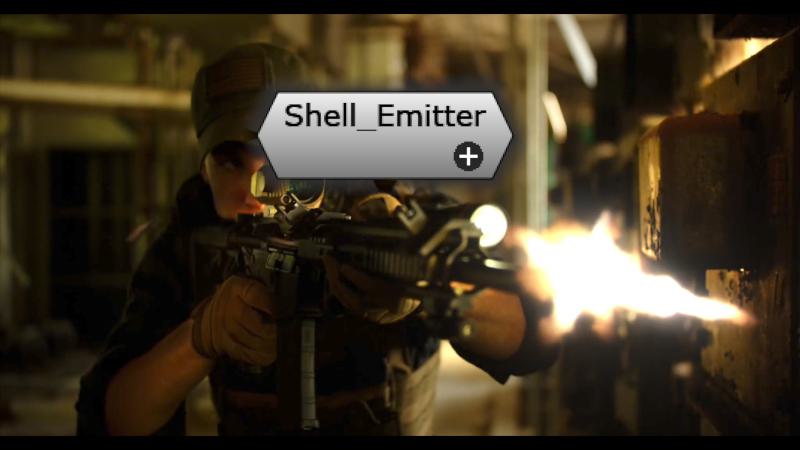
Overview
A Nuke Group Node that simulates shell casings ejecting from a chamber. Each shell follows a arc driven by simple physics. No particle system needed, just transformation math evaluated frame by frame.
Built this for a muzzle flash comp where I needed shells to fly out. I remembered my first physics class where we had to calculate a ball’s trajectory. Turns out it came handy for this assignment making the work less repetitive.
Result Preview
Shell Trajectroy Preview
The Physics
Projectile motion
Each shell is an independent projectile. The Transform node moves it every frame
based on how much time has passed since it spawned. If a shell spawns at frame 50
and we are at frame 65, then t = 15 frames have elapsed.
Where is the muzzle spawn position, is horizontal speed, is the initial upward velocity, is gravity, and is frames since spawn.
Breaking down the expression
The Y-position expression in the node looks like this:
[expression parent.Chamber_pos.y(43)] - center.y
+ (parent.arc_height * (1 + (random(44) * parent.rand_arc)) * (frame - 43))
- (0.5 * parent.gravity * pow(frame - 43, 2))
Breaking it down:
Chamber_pos.y(43)reads the muzzle Y at the spawn frame- center.yconverts from absolute position to a relative offsetarc_height * (frame - 43)is the initial upward velocity over time(1 + random * rand_arc)adds per-shell variation to the arc- 0.5 * gravity * pow(frame - 43, 2)is the gravity term pulling it down
The X formula is simpler, just constant velocity with a random speed offset:
[expression parent.Chamber_pos.x(43)] - center.x
+ ((frame - 43) * parent.side_speed * (1 + (random(43) * parent.rand_speed)))
Implementation
Multiple shells
Six shells spawn at different frames: 43, 50, 58, 63, 70, 75. Each has its own
Transform node with identical expressions but a different hardcoded spawn frame.
They all get merged together at the end.
Visibility
Each Merge node has a mix expression that keeps the shell invisible outside its lifetime window:
frame >= 43 && frame <= 43 + parent.life_span ? 1 : 0Randomness
random() in Nuke is seeded by its argument, so passing different values per
shell gives each one unique but stable variation. Same seed always returns the
same value, so the motion is repeatable across renders.
Parameters
| Parameter | Description |
|---|---|
| Chamber Position | Animated XY tracking where shells spawn |
| Base Height | Initial upward velocity, higher arcs more |
| Gravity | Downward pull over time |
| Forward Speed | Horizontal ejection speed, negative ejects left |
| Arc Randomness | Per-shell variation in vertical velocity |
| Speed Randomness | Per-shell variation in horizontal velocity |
| Base Spin Speed | Rotation speed in degrees per frame |
| Scale | Shell size multiplier |
| Life Span | How many frames each shell stays visible |
Python Code
def shell_emitter():
    spawn_frames =[43, 50, 58, 63, 70, 75]

    group = nuke.nodes.Group(name="Shell_Emitter")
    group.setXYpos(100, 50)

    with group:
        group.addKnob(nuke.Tab_Knob("ShellPhysics", "Shell Physics"))
        group.addKnob(nuke.XY_Knob("Chamber_pos", "Chamber Position"))
        group.addKnob(nuke.Text_Knob("arc_settings", "", "<b>Arc Settings</b>"))

        arc_height = nuke.Double_Knob("arc_height", "Base Height")
        arc_height.setRange(0, 100)
        arc_height.setValue(25.5)
        group.addKnob(arc_height)

        gravity = nuke.Double_Knob("gravity", "Gravity")
        gravity.setRange(0, 10)
        gravity.setValue(9.2)
        group.addKnob(gravity)

        side_speed = nuke.Double_Knob("side_speed", "Forward Speed")
        side_speed.setRange(-100, 100)
        side_speed.setValue(-55)
        group.addKnob(side_speed)

        group.addKnob(nuke.Text_Knob("randomness", "", "<b>Randomness</b>"))

        rand_arc = nuke.Double_Knob("rand_arc", "Arc Randomness")
        rand_arc.setValue(0.175)
        group.addKnob(rand_arc)

        rand_speed = nuke.Double_Knob("rand_speed", "Speed Randomness")
        rand_speed.setValue(2)
        group.addKnob(rand_speed)

        group.addKnob(nuke.Text_Knob("visuals", "", "<b>Visuals</b>"))

        global_spin = nuke.Double_Knob("global_spin", "Base Spin Speed")
        global_spin.setRange(-100, 100)
        global_spin.setValue(84)
        group.addKnob(global_spin)

        global_scale = nuke.Double_Knob("global_scale", "Scale")
        global_scale.setRange(0, 2)
        global_scale.setValue(1)
        group.addKnob(global_scale)

        life_span = nuke.Int_Knob("life_span", "Life Span")
        life_span.setValue(40)
        group.addKnob(life_span)

        img = nuke.nodes.Input(name="img")
        img.setXYpos(0, -1000)

        transforms = {}
        for f in spawn_frames:
            t = nuke.nodes.Transform(name="T{}".format(f))
            t.setInput(0, img)
            t.setXYpos(0, -1000 + (spawn_frames.index(f) + 1) * 100)

            tx_expr = "[expression parent.Chamber_pos.x({f})]-center.x+((frame-{f})*parent.side_speed*(1+(random({f})*parent.rand_speed)))".format(f=f)
            ty_expr = "[expression parent.Chamber_pos.y({f})]-center.y+(parent.arc_height*(1+(random({r})*parent.rand_arc))*(frame-{f}))-(0.5*parent.gravity*pow(frame-{f},2))".format(f=f, r=f+1)

            t['translate'].setExpression(tx_expr, 0)
            t['translate'].setExpression(ty_expr, 1)
            t['rotate'].setExpression("(frame-{f})*parent.global_spin".format(f=f))
            t['scale'].setExpression("parent.global_scale")
            t['center'].setExpression("input.width/2", 0)
            t['center'].setExpression("input.height/2", 1)

            transforms[f] = t

        prev = None
        for f in spawn_frames:
            m = nuke.nodes.Merge2(name="M{}".format(f))
            m.setXYpos(400, -1000 + (spawn_frames.index(f) + 1) * 100)
            m.setInput(1, transforms[f])
            m.setInput(0, prev)
            m['mix'].setExpression("frame>={f}&&frame<={f}+parent.life_span?1:0".format(f=f))
            prev = m

        out = nuke.nodes.Output(name="Output1")
        out.setInput(0, prev)
        out.setXYpos(400, -100)
shell_emitter()